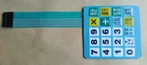
The top layer of a membrane switch is an overlay of the key the user sees and touches. Membrane switches work much like mechanical switches and are what product designers are looking for. Instead of using mechanical parts separately from switches and keys, electrical circuits are printed on membrane keypads.
On the top layer, two layers of a circuit are printed on the membrane, usually, polyethylene terephthalate (PET), to create the circuit corresponding to the button. On the other hand, membrane switches are made of silver, copper, or graphite material known as ink for membrane switches. The ink is used for its conductive properties, and the materials silver, copper, or graphite are known for their conductivity.
Membrane switches are advanced switches used in various applications in the world today for various purposes, such as electronic devices, computers, sensors, and other devices.
Membrane touch switches have become the norm because they improve the aesthetics of human-machine interfaces while being less expensive and more durable than other switches. They are widely used in electronic devices such as mobile phones, tablets, computers, and other devices and have proven to be more efficient, reliable, and less prone to failure than conventional switches and to a longer life.
While membrane probes look very different and aesthetics may or may not play a role in their application, the basic construction of the membrane probes is the same. There are a number of different types of PCB materials (PCB-to-membrane switches) that can be used to manufacture membrane switches. In contrast to silver flex diaphragm switches, PCB diaphragm switches can be both tactile and non-tactile.
The click sensation is due to the tactile dome, which is made of polyester or metal, and to the non-tactile surface of the membrane probe.
Understanding the difference between the tactile and non-tactile reactions of a membrane switch can act as a drag-off. To get a solid answer, you need to understand the differences in the physical properties of the membrane probe and the touch-sensitive dome.
Circuit boards typically rely on membrane switches to switch parts of a device off and on. Some are called tactile membrane switches, others are called non-tactile membrane switches. Here is a look at the differences in the physical properties of the membrane probe and the touch-sensitive dome.
Non-tactile switches rely not on a dome-like a button to operate the switch or provide direct feedback from the user - but on a membrane probe.
This type of film switch is without electrical connection and can be printed on paper, plastic, metal, glass, or other materials with or without electrical circuits.
To compensate for the lack of tactile feedback, these non-tactile switches are often designed to give the impression that they are combined with an electrical circuit such as a light bulb or LED. There are several different circuits and actuation types that can be integrated into the polyester-shaped dome.
For additional functionality, other electronic components such as power supply, battery, or even light bulb can be mounted on the membrane switcher.
Low-profile LED resistors and capacitors can be integrated into the circuit design to provide the user with extended feedback options. LED Light - Light-emitting diodes (LEDs) or other light bulb components can be integrated, making the membrane switch an ideal candidate for use as a power supply or battery charger.
The diaphragm switch is a multi-layer momentary switch consisting of a single resistor, two capacitors, and two resistors and one capacitor. It is durable and has a low profile, which saves space - design, and adaptability for any project.
While mechanical switches are the most common, membrane keypads have become a popular alternative for manufacturing companies in recent years. They are designed for printed circuits on flexible substrates and have a lower profile than other electrical switches. They are becoming increasingly popular as designers seek a more modernized look, avoid the old bulky switches and look for ways to incorporate the switches into today's devices on a smaller footprint.
The compact and slim design allows manufacturers to use membrane keypads and other applications that require a flat design.
Non-tactile membrane keypads are shapes and sizes that can be adjusted for active keyboard areas, but they do not give the user feedback like tactile membrane keypads. This includes LED lights that light up when the button is pressed but do not give any feedback when pressed, which tactile is the case - the slide switch. For example, a non-tactile membrane contact switch can perform up to 3 million actuations, while a tactile membrane contact switch can perform 1 million actuations.
Membrane touch buttons are generally a combination of two activated circuits and one non-activated circuit or a switch with two poles. This means that the switch is pressed so that its two poles make direct contact and close the circle between them. Membranes touch switches can be thought of as momentary action, as they work by pressing a clasp.