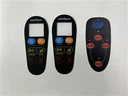
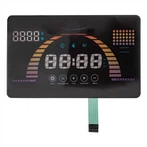
Graphic Overlay With Capacitive Circuit Layer and Adhesive Layer
A touch panel is a type of interface device that allows users to interact with a device or computer system by touching the screen directly with their fingers or a stylus. Touch panels have become increasingly popular in recent years and are used in a variety of devices, including smartphones, tablets, and laptops.
One type of touch panel is a capacitive touch panel, which is designed to detect the capacitance or electrical charge of a user's finger when it comes in contact with the screen. Capacitive touch panels are more durable and accurate than other types of touch panels, and they can detect multiple touch points at the same time.
The capacitive circuit layer is a key component of a capacitive touch panel. It consists of a grid of electrodes that are embedded in a thin layer of transparent film and coated with a conductor material, such as indium tin oxide (ITO). When a user touches the screen, their finger's electrical charge changes the capacitance between the electrodes, which is then detected by the touch panel's controller.
Another important component of a touch panel is the adhesive layer, which is used to attach the capacitive circuit layer to the glass or plastic surface of the device. The adhesive layer must be strong and flexible enough to withstand daily wear and tear, while also providing excellent optical clarity and resistance to scratches and other damage.
There are many different types of adhesive layers used in touch panels, including pressure-sensitive adhesives, double-sided tapes, and liquid adhesives. Each type has its own advantages and disadvantages, depending on factors such as cost, ease of application, and durability.
In general, touch panels with capacitive circuit layers and robust adhesive layers are highly reliable and responsive, making them ideal for use in a wide range of applications. They are used not only in consumer electronics but also in industrial and medical devices, where accuracy, durability, and ease of use are critical factors.
In conclusion, touch panels with capacitive circuit layers and strong adhesive layers are a key component in modern touch screen technology. They provide accurate and reliable input capabilities, allowing users to interact with devices in more natural and intuitive ways. With their widespread use in consumer, medical and industrial devices, the technology surely has a bright future, paving the way for innovative and intuitive ways of interacting with the digital world.
1. Working temperature: - 20 ºC -+ 70 ºC
2. Storage temperature: - 40 ºC - + 85 ºC, 95% ± 5%
3. Atmospheric pressure: 86 - 106kpa
1. Reliability service life: > 1 million times.
2. Standard working force: 100 - 750g.
3. The silver paste line is free of oxidation and impurities
4. silver paste line width ≥ 0.3mm.
5. pin spacing standard 2.54, 2.50, 1.27, 1.25, 1.0, 0.5mm.
6. The bending resistance of tail cable shall be rolled 80 times with d = 10mm steel rod.
7. The adhesion of printing ink should be passed test by Cross-Cut Tester.