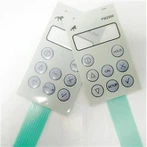
Basic structure of light-emitting membrane switch
Generally speaking, the common light-emitting membrane switch is mainly composed of 6 layers of materials, which are panel, surface glue, upper circuit, isolation layer, lower circuit, and bottom glue in the order from the surface to the inside. The structure of each layer is described below:
1. Panel: The panel is the "coat" of the entire light-emitting membrane switch. On the basis of properly arranging the keys, through different colors, patterns and key shapes, the entire light-emitting membrane switch plays a necessary decorative role. The main function of the panel layer is to play the role of marking and keying, so the selected materials must have the characteristics of high transparency, high ink adhesion, high elasticity, and anti-folding properties.
2. Upper circuit, lower circuit: The upper and lower circuits are the electrical components of the light-emitting membrane switch, and are also the "off" and "key" of the switch. It is formed by printing a layer of conductive material on it. The upper and lower circuits play the two roles of electric shock necessary for the switch to close. The thickness is generally within 0.05--0.175MM, and the most common is 0.125MM PET.
3. Top adhesive, isolation layer, primer: the materials of these three-layer structures are double-sided adhesives, which have different names due to different positions in the switch structure. The three layers of double-sided tape have different thicknesses depending on their respective layers. This is mainly determined by the thickness of the switch and the operating force of the keys.
Working principle of luminous membrane switch
The basic working principle of the light-emitting membrane switch is as follows: when the panel is not pressed, the light-emitting membrane switch is in a normal state, its upper and lower contacts are disconnected, and the isolation layer isolates the upper and lower lines; when the panel is pressed When it goes down, the contacts of the upper circuit are deformed downward, overlap with the lower circuit and make the circuit conduct, and the circuit after conduction sends a signal to the external connecting instrument (substrate), so as to realize its corresponding function; when the finger is released , the upper circuit contacts bounce back, the circuit opens, and the circuit triggers a signal.
Light-emitting membrane switch Light-emitting membrane switch, also known as light touch keyboard, adopts the overall sealing structure composed of plane and multi-layer combination, which is the key switch, panel and mark. A new type of electronic component that integrates light, mechatronics, and electricity with symbol display and liner sealed together. It is a fundamental change in the appearance and structure of electronic products. It can replace the buttons of conventional discrete components and execute the operating system more reliably. task.
1. The light-emitting membrane switch has good waterproof, dust-proof, oil-proof, anti-harmful gas erosion, stable and reliable performance, light weight, small size, long life, convenient assembly and connection, the panel can be washed without damage to the characters, and the colors are rich. , beautiful appearance and so on. Make your products more contemporary with illuminated membrane switches.
2. The main type of luminous membrane switch The luminous membrane switch panel is a kind of rigid or flexible printed circuit board as the base, installed with touch or no touch buttons, and then covered with plastic (polycarbonate) printed with colorful decorative patterns. Ester PC, polyester PET, etc.) film panels.
3. It is an electronic component integrating switch function and decorative function, which is a new type of man-machine dialogue interface. The connection between the switch circuit and the whole machine can be done by welding or plugging.
Application of luminous membrane switch:
1. Computer: operating keyboard, monitor, printer, plotter;
2. Household appliances: remote controls, electronic locks, washing machines, microwave ovens, rice cookers, audio and video equipment, etc.;
3. Office systems: telephones, fax machines, copiers, counters;
4. Electronic toys: electronic organ, game console, electronic target;
5. Instrumentation: measuring instruments, analytical instruments, marine instruments, medical instruments;
6. Mechanical and electrical products: CNC machine tools, electronic scales, robots, printing machinery.
7. Light-emitting membrane switches have been widely used in electronic communication, electronic measuring instruments, industrial control, medical equipment, automobile industry, smart toys, household appliances and other fields.
Precautions for the use of light-emitting membrane switches
1. First of all, the bubble film lining between the light-emitting membrane switch and the light-emitting membrane switch is to reduce the pressure of the keys and prevent them from failing, and should be retained.
2. The transparent film on the front and back of the display window of the luminous membrane switch is to protect the luminous membrane switch, so do not tear it off easily.
3. After taking out some of the light-emitting membrane switches, they should be bundled as they are, but they must not be bundled too tightly.
4. Membrane surface stickers and light-emitting membrane switches with a feel and a large number need to be boxed and placed vertically to prevent the keys from failing under heavy pressure for a long time.
5. The outgoing wires of the light-emitting membrane switch should be well protected, and the outgoing wires should not be placed down.
6. The light-emitting membrane switch with display window must prevent the material from bending under force when handling and placing, which will leave creases.
7. The light-emitting membrane switch should be stored in a room at room temperature, and should be treated with dust and moisture, and there is no acid, alkali or other corrosive gases in the surrounding air.
Light-emitting membrane switch structure and application
1. The panel layer is generally made of exquisite patterns and texts on silk-screened PET, PC and other colorless light-transmitting sheets less than 0.25MM. Because the main function of the panel layer is to play the role of identification and buttons, the selected materials must have High transparency, high ink adhesion, high elasticity, high toughness and other characteristics.
2. The main function of the surface glue is to closely connect the panel layer and the circuit layer to achieve the effect of sealing and connection. This layer generally requires a thickness between 0.05-0.15MM, with high viscosity and anti-aging properties; In production, special double-sided adhesives for luminous membrane switches are generally used. Some luminous membrane switches require waterproof and high temperature resistance, so the surface adhesives must also use materials of different properties according to needs.